


We’re kicking off the school year with a brand-new blog series! In it, we want to bring you a little closer to the different technologies that make up HYIELD. That way, over the course of the project, you’ll be able to follow our journey, share in our victories, and—fingers crossed—only a few bumps on the road.
The concept is simple enough: biomass goes in, hydrogen comes out. But we figured it’s about time we unravel what happens in between, in a way that us mere mortals—without a PhD in hydrogen—can still understand.
To do this, we’ll break things down into six blog posts, each focused on one of HYIELD’s key innovations:
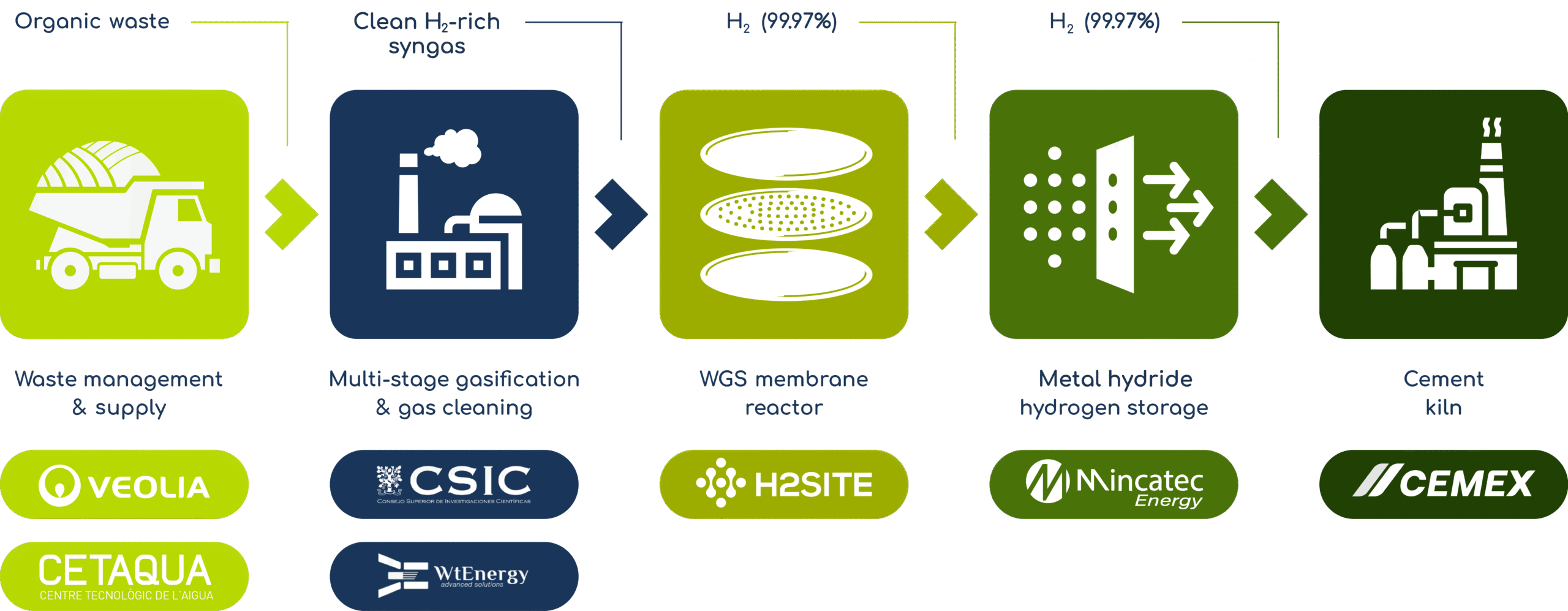
- Biomass selection – Our partner Veolia is in charge of supplying the 3,900 tonnes we’ll process during the project. But here’s the tricky part: not all waste is suitable for hydrogen. Moisture, contaminants and inconsistent quality can make the process fail. That’s why one of the first steps in HYIELD is carefully mapping and testing local waste streams to make sure the feedstock is reliable. Curious about which types of biomass? That’s the topic of our next post!
- Gasifier – WTE will take the lead in the hottest stage of the process, where a multi-stage steam-oxygen and plasma-assisted gasification system converts waste into hydrogen-rich syngas. The setup includes a fluidized bed gasifier and a high-temperature plasma reactor to crack tars and optimize gas quality. CSIC supports this work by testing different waste types and operating conditions to analyze syngas composition and conversion efficiency. Together, they ensure the system is robust, efficient, and ready to handle a wide range of feedstocks. We will provide further details on the products to be analyzed and the methods used in next blogs!
- Membrane reactor – In our reactor, we combine the WGS (Water-Gas Shift) reaction and hydrogen separation in a single unit with H2Site’s technology. Do you know which chemical reactions take place and how we separate the different compounds? Stay tuned.
- Storage – Mincatec has years of experience in hydrogen storage—one of today’s biggest challenges. In HYIELD, the H₂ storage process involves assembling several metal hydride tanks, and integrating them into a multi-tank system with thermal and energy management to optimize performance, safety and efficiency.
- Digital twin – To keep things state-of-the-art, EURECAT is building an AI-driven digital twin of the entire waste-to-syngas-to-H₂ plant, from design through final validation. Once tested and validated, the digital twin will be used to simulate and evaluate its applicability in other industrial sectors such as steel and copper, testing different workflows, heat integration strategies, including auto-thermal, allo-thermal, and concentrated solar heat, and enabling the extrapolation of hydrogen production processes beyond the cement industry.
- Final users – And finally, the big question: what will all this hydrogen be used for, and who will be using it?
We hope this little introduction has whetted your appetite, and that you’re just as eager as we are to discover what’s next!
The project is Co-founded by Clean Hydrogen Partnership and European Commission.